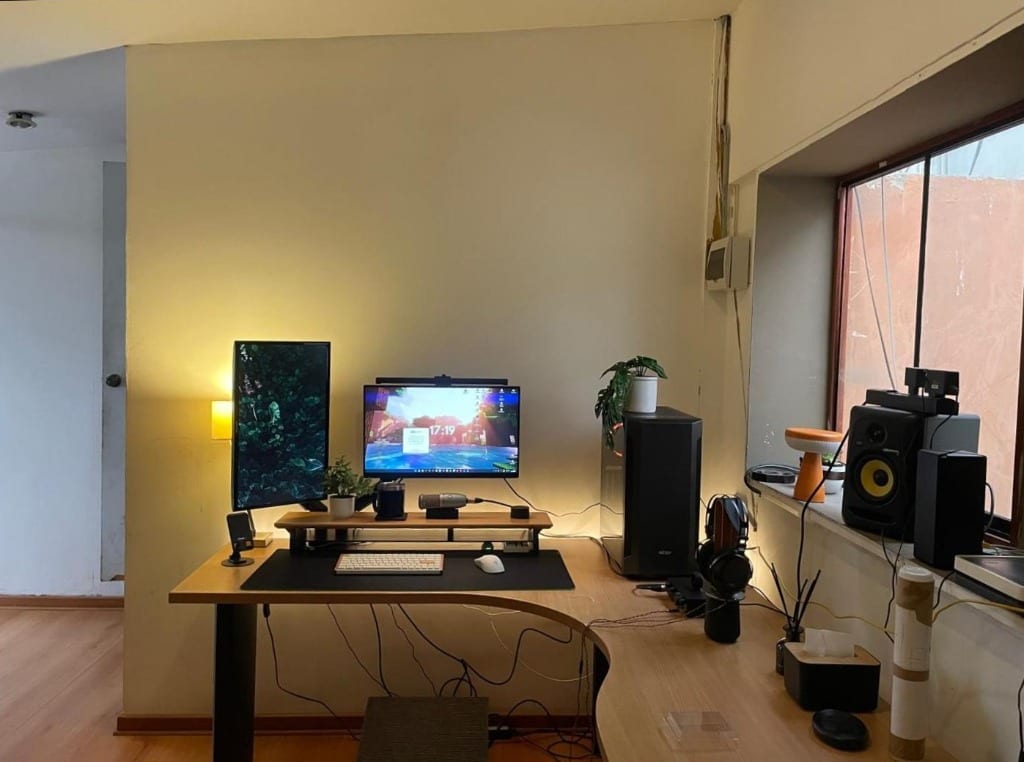
Design Concept
Window Garden Work Nook
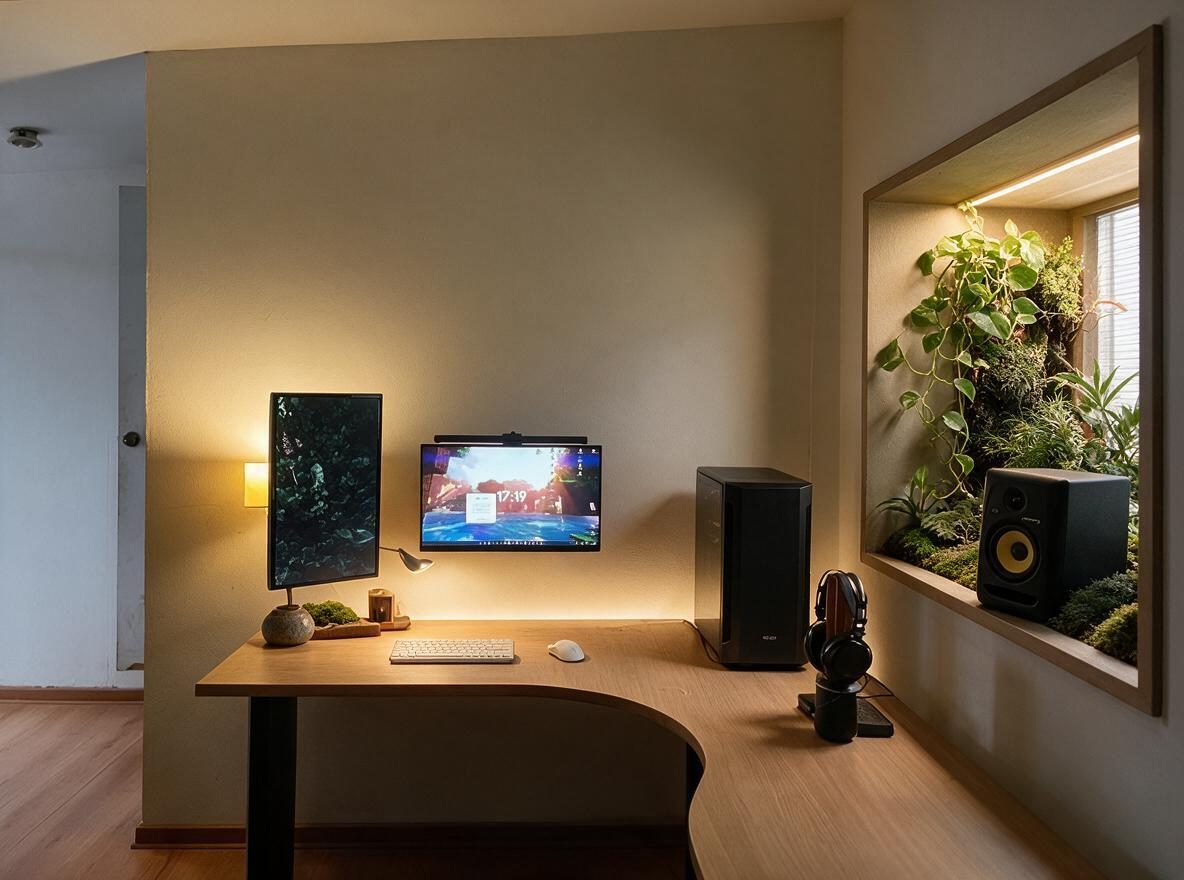
The central challenge was a corner that felt simultaneously bare and cluttered—empty wall space competed with visual noise from mismatched gear. The design anchors the room on a single biophilic moment: a recessed window converted into a living garden with integrated LED grow lighting. This move absorbs visual weight from the desktop, gives the eye a natural resting point, and uses vertical depth to reclaim wasted corner volume. The curved desk echoes the garden's organic geometry, while three independent lighting zones—warm task, monitor bias, and plant-specific—create intentional hierarchy without overhead dependence. Every object now serves either function or biophilic connection; nothing sits without purpose.
Key Decisions
- Curved desk orientation — the existing desk rotates to wrap the user toward the window garden, eliminating the dead zone behind a straight desk and creating continuous workflow surface.
- Recessed window as living terrarium — built-in depth becomes an asset with layered moss, trailing pothos, and ferns under dedicated grow strips, replacing a blank wall with filtered natural views.
- Three-zone lighting strategy — wall-mounted sconce for warm task light, monitor-mounted bias light for eye comfort, and concealed LED strips for plant health and evening ambience.
- Vertical monitor pairing — portrait secondary display clears horizontal surface while the landscape primary maintains natural sight lines toward the garden.
Material Plan
| Item | Role | Est. Price | Where to Buy |
|---|---|---|---|
| Full-spectrum LED grow strip, 24" | Supports window garden health; provides hidden evening glow | $25-45 | Amazon, IKEA VÄXER |
| Trailing pothos + moss terrarium kit | Establishes biophilic density with low maintenance | $35-70 | Local nursery, Amazon, The Sill |
| Adjustable monitor-mounted bias light | Reduces eye strain; creates floating screen effect | $30-60 | Amazon, BenQ ScreenBar alternatives |
| Ceramic task lamp with warm bulb | Delivers 2700K focused light; replaces harsh overhead | $40-80 | Target, IKEA, Wayfair |
| Solid wood monitor riser/organizer | Unifies vertical display with desk material | $25-55 | Amazon, IKEA, Etsy |
| Weighted headphone stand | Corrals desktop clutter; adds vertical sculptural element | $20-40 | Amazon, AliExpress |
Budget Snapshot
| Category | Est. Cost |
|---|---|
| Lighting (3-zone system) | $95-185 |
| Living garden materials | $70-140 |
| Desktop organization + accessories | $65-150 |
| Soft furnishings & finishing | $50-100 |
| Total | $280-575 |
Implementation Note
The grow strip must run on a timer cycle—typically 12-14 hours—to prevent mold in the recessed window cavity; manual daily switching almost always fails within three weeks. Position the strip at the garden's rear top edge to cast forward through foliage, mimicking natural skylight rather than creating flat front-wash.